Your Skin Deserves More Than a One-Size-Fits-All Routine.

Flawless Skin Boutique’s exclusive skin maintenance membership, created for those who want to look refreshed, radiant and beautifully maintained all year long.


Updated October 2026
You finally got your breakouts under control. Maybe it took years of prescriptions, a strict routine, or simply growing out of it. And then you noticed what acne left behind: dents, pits, and shadows that show up in every ring light, phone camera, and harsh bathroom mirror.
A deep acne scar can feel more frustrating than the acne itself, because it does not clear up on its own. The good news is that many deep scars can be meaningfully improved without surgery. The key is knowing which type of scar you have, because each one responds differently. At Flawless Skin Boutique in Buckhead, Atlanta, that assessment shapes every treatment plan.
A deep acne scar forms when severe inflammation damages the deeper layers of skin and the collagen that supports it. As the skin heals, it pulls downward or loses volume, leaving a depression below the surrounding surface. Cystic and nodular acne are the most common culprits.
Most deep acne scars fall into one of three types.
Rolling scars have soft, sloping edges that create a wavy or uneven texture. They are caused by bands of tissue tethering the skin to deeper structures. Rolling scars often look worse in overhead lighting and tend to respond well to collagen-building treatments and fillers.
Boxcar scars are wider depressions with sharper, defined edges. Shallow boxcar scars often improve with resurfacing and collagen stimulation. Deeper ones may need more sessions or a combination of approaches.
Ice pick scars are narrow, deep, and pointed, almost like a large open pore. They are the most stubborn type. The American Academy of Dermatology notes that ice pick scars require different treatment than rolling scars, and very deep ice pick scars sometimes need surgical techniques performed by a dermatologist or plastic surgeon.
Yes, in many cases. Rolling scars and many boxcar scars can be significantly softened with non-surgical treatments that rebuild collagen or restore volume from beneath. Very deep, narrow ice pick scars are harder to reach and may improve only partially with non-surgical care.
The realistic goal is smoother texture and less visible scarring, not perfect skin. Most people need several sessions, and improvement continues for months after treatment as new collagen forms.
Most deep acne scars respond best to a combination plan rather than a single treatment. Collagen-stimulating treatments improve texture over time, while fillers can provide immediate lift for certain scars.
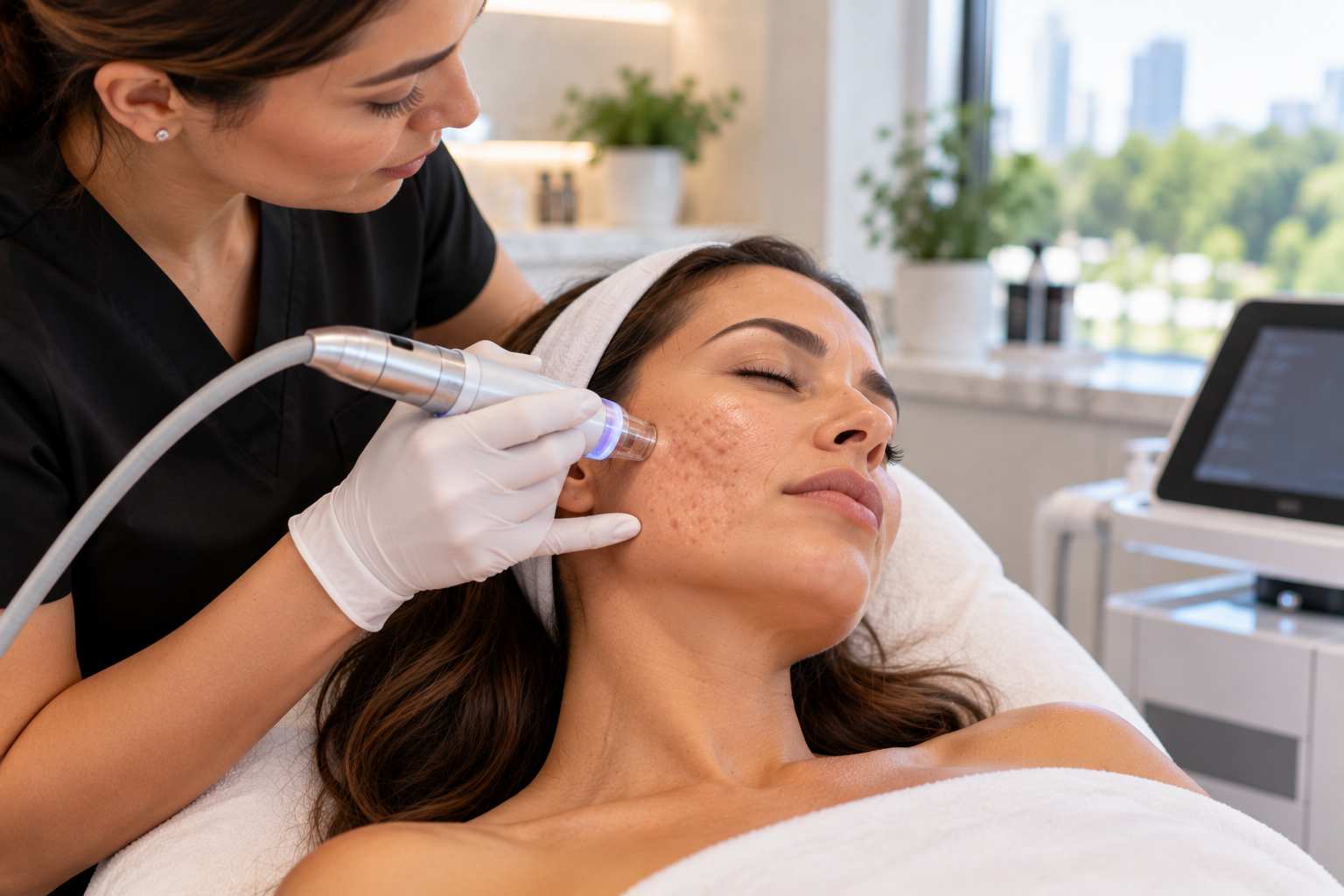
Microneedling with SkinPen and AnteAGE MD serums creates controlled micro-channels that trigger your skin's natural healing response and new collagen production. SkinPen was the first microneedling device to receive FDA clearance, and the FDA has authorized microneedling devices to improve the appearance of facial acne scars in adults 22 and older. Sessions are typically spaced four to six weeks apart, with results continuing to develop for up to six months.
PRP microneedling pairs microneedling with platelet-rich plasma drawn from your own blood. The goal is to support healing and collagen production, and Flawless Skin Boutique uses it to help minimize the visibility of acne scars and other textural imperfections. Studies on PRP for acne scarring are promising, but the research is still evolving, so it is best viewed as an enhancement rather than a guaranteed result.
Venus Viva MD uses NanoFractional Radio Frequency to deliver controlled heat into deeper layers of the skin, encouraging collagen and elastin production. It is used for acne scars, uneven texture, and enlarged pores. Most people need three to four treatments for optimal results, with redness and slight swelling for a few days afterward.
For soft rolling scars, dermal fillers can lift the depressed area so it sits closer to the surrounding skin. The improvement is visible right away. Some fillers are FDA-approved for correcting acne scars, though results are temporary for most products and will need maintenance. Fillers are less effective for narrow ice pick scars.
For people in their late teens and twenties, acne scarring often arrives right as life gets more visible: first jobs, dating apps, graduation photos, and a camera that is always on. Filters can hide texture online, but they do not help in person.
If you are in this stage of life, a few things are worth knowing:
If you still have occasional breakouts with oily skin and enlarged pores, your provider may also discuss Microtox for acne, which targets oil production and the appearance of active acne. It does not treat scars, but it may be part of an overall plan to keep new breakouts from forming.
Men often have thicker skin, larger pores, and more active oil glands, which can make deep acne scars more pronounced, especially along the cheeks and jawline. Many men also put off treatment because they assume nothing can be done or that recovery will be obvious.
Here is what makes scar treatment more practical than many men expect:
Most deep acne scar treatments involve a consultation, a numbing step, a short procedure, and a few days of visible healing. Results build gradually over a series of sessions.
After microneedling or radiofrequency, it is common to experience:
Protect your skin carefully during this time. The AAD recommends a broad-spectrum sunscreen with SPF 30 or higher, and the FDA advises avoiding significant sun exposure for two weeks around microneedling. Sun can darken healing skin and make scars look more obvious, which is especially important in Atlanta's long, sunny seasons.
The best treatment depends on the scar type. Rolling scars often respond well to microneedling, radiofrequency, and fillers. Boxcar scars improve with collagen-stimulating treatments over several sessions. Very deep ice pick scars may need surgical techniques from a dermatologist.
Deep acne scars rarely fade significantly on their own because the underlying collagen has been lost or damaged. Some temporary redness or discoloration after acne may fade, but true textural scars usually need treatment to improve.
Most people need three to six sessions spaced several weeks apart. Deeper or more widespread scarring may require more sessions or a combination of treatments.
Both stimulate collagen, and both can improve pitted scars. Venus Viva MD adds controlled heat for deeper remodeling, while SkinPen microneedling is a well-studied, FDA-cleared option. Many plans combine approaches based on how the scars respond.
Numbing cream is applied before microneedling, and most people describe the sensation as mild prickling or vibration. Radiofrequency treatments can feel warm and slightly prickly.
A deep acne scar does not have to be a permanent part of how you see yourself. With the right diagnosis and a thoughtful, step-by-step plan, many people see real softening in texture and a more even, confident complexion.
If you are ready to find out which treatments fit your scars, reserve a consultation at Flawless Skin Boutique, 110 E. Andrews Dr NW, Suite 203, in Buckhead, Atlanta. Call 678-263-2777 with questions. We will look closely at your skin and map out a plan that fits your goals and your life.

Our Collagen Elixir is a potent skincare ally, promoting elasticity and hydration. Its rich blend of amino acids supports skin regeneration, reducing wrinkles and fine lines for a youthful, radiant complexion.